
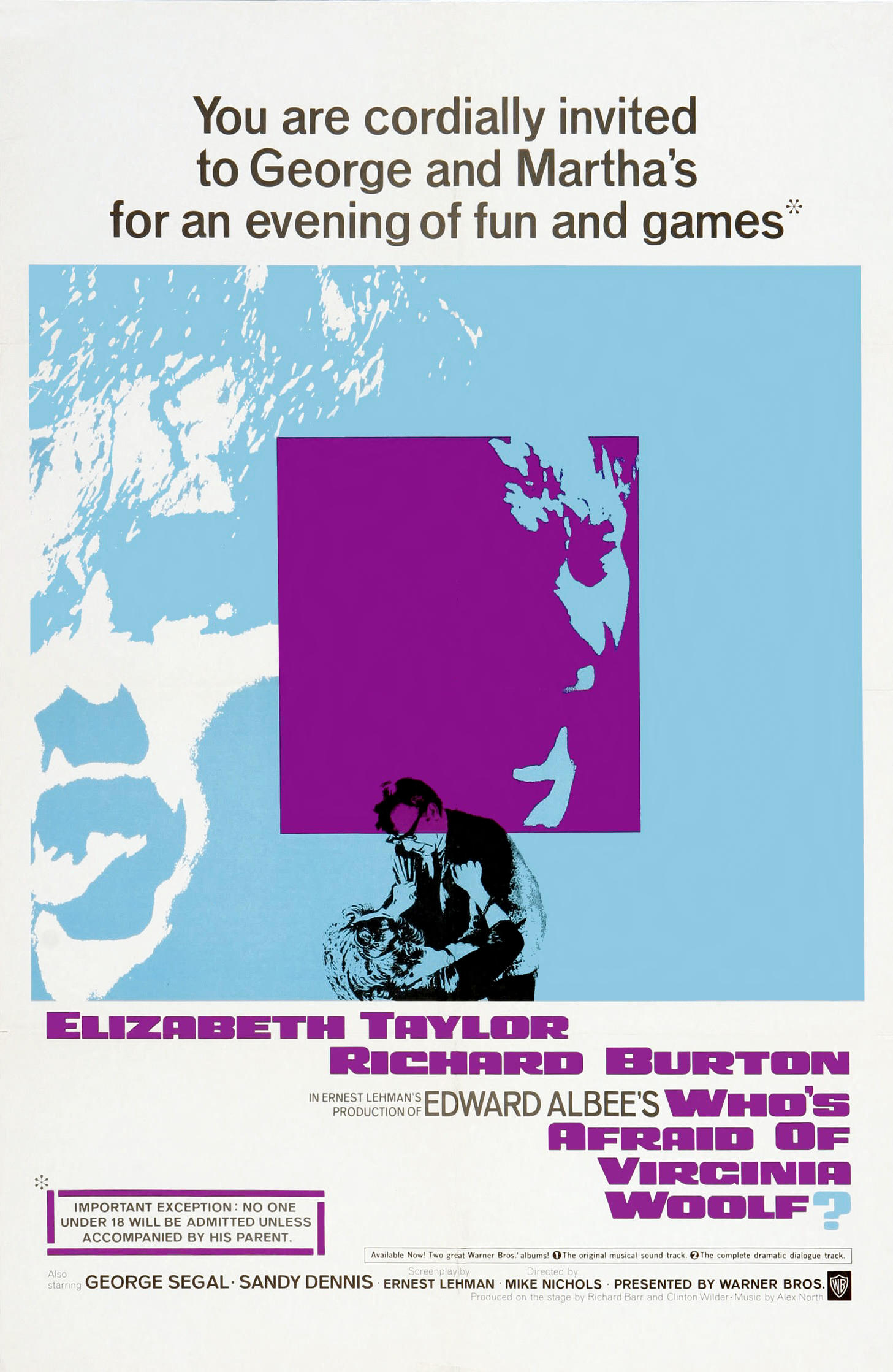
Studio: Warner Brothers
Running time: 131 minutes
Who’s Afraid of Virginia Woolf? (1966)
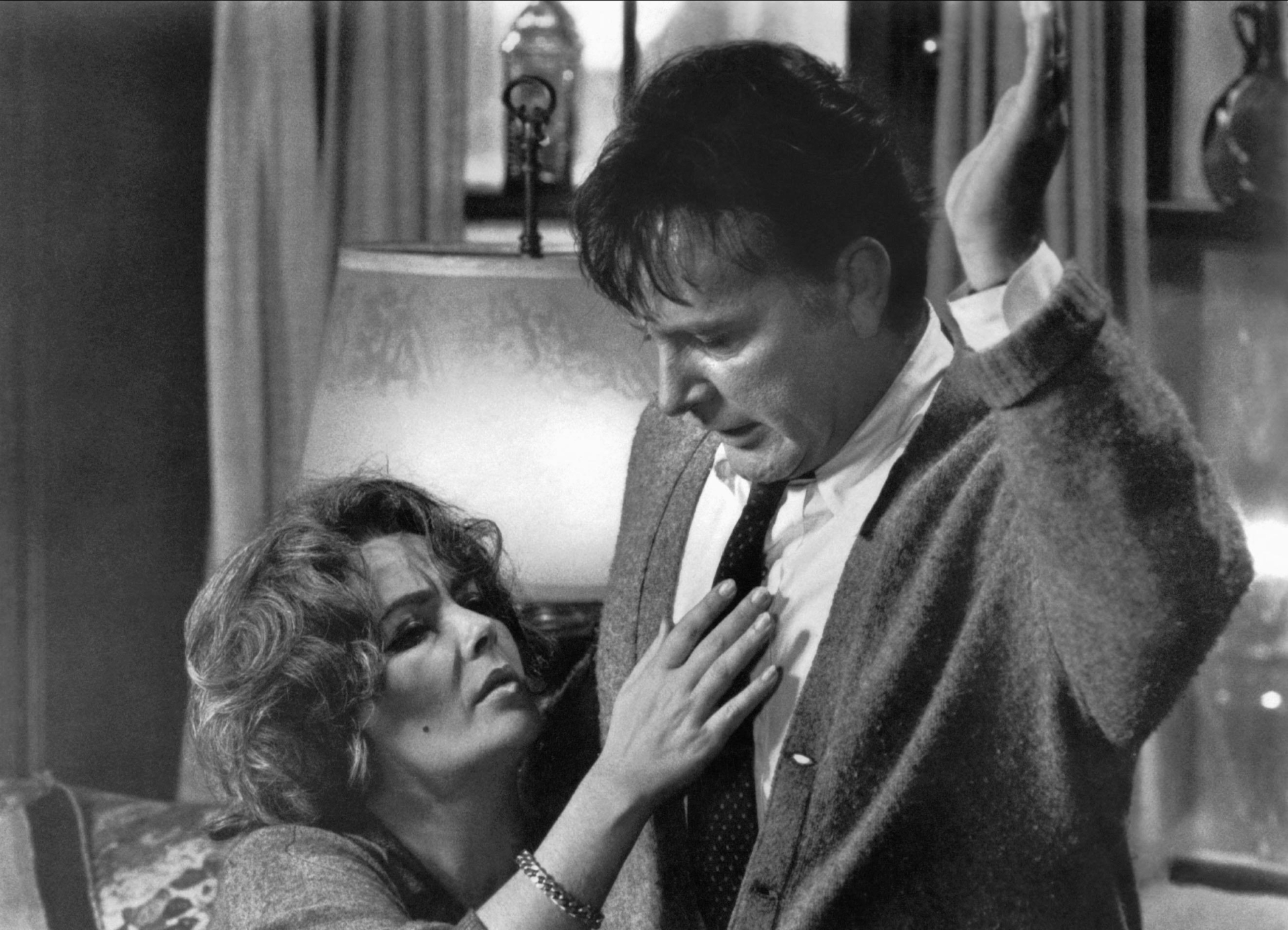
“Elizabeth Taylor and Richard Burton are ideal as malevolent marrieds Martha and George in first-time-director Mike Nichols’ searing film of Edward Albee’s groundbreaking Who’s Afraid of Virginia Woolf? Taylor won her second Academy Award (and New York Film Critics, National Board of Review and British Film Academy Best Actress Awards). Burton matches her as her emotionally spent spouse. And George Segal and Best Supporting Actress Oscar winner Sandy Dennis score as another couple straying into their destructive path. The movie won a total of five Academy Awards and remains after five decades a taboo-toppling landmark.” [From the Blu-ray]
Cast
Martha: Elizabeth Taylor
George: Richard Burton
Nick: George Segal
Honey: Sandy Dennis
Crew
Director: Mike Nichols
Producer: Ernest Lehman
Screenwriter: Ernest Lehman
Based on the Play by: Edward Albee
Cinematographer: Haskell Wexler
Production Designer: Richard Syllbert
Set Decorator: George James Hopkins
Musical Score: Alex North
Editor: Sam O’Steen
Costumes: Irene Sharaff
Miss Taylor’s Make-up: Gordon Bau
Mr. Burton’s Make-up: Ronnie Berkeley
Supervising Hairstylist: Jean Burt Reilly
Did You Know?
There was talk of Uta Hagen and Arthur Hill reprising the roles they originated on Broadway in the film adaptation of Who’s Afraid of Virginia Woolf? Playwright Edward Albee had wanted Bette Davis and James Mason. But Ernest Lehman, who produced the film and was credited with its screenplay, hit upon another idea for the role of Martha: Elizabeth Taylor. “I had seen a photograph of Elizabeth angrily pointing her finger at Mike Todd in a manner I immediately saw as ‘Martha-like,’” said Lehman. “I remember standing on line to watch the film of The Night of the Iguana, and the thought came to me, ‘How would all these people feel if they could see Elizabeth Taylor in Virginia Woolf?’”
Lehman traveled to Paris, where the Burtons were making The Sandpiper, to gauge her interest. Elizabeth couldn’t conceive of herself in the role. Richard, however, encouraged her to take the part. “You’d better do it to stop anyone else from doing it and causing a sensation.” She was sold.
Elizabeth received a whopping $1.1 million and 10% of the gross to play opposite Richard as George. Her contract gave her director approval, and Elizabeth and Richard’s suggestion was both bold and unconventional: Mike Nichols. A personal friend of the Burtons, Nichols may have been the toast of Broadway, but he had never before directed a film. However, they recognized in him all the qualities required to extract the searing performances to sustain the film.
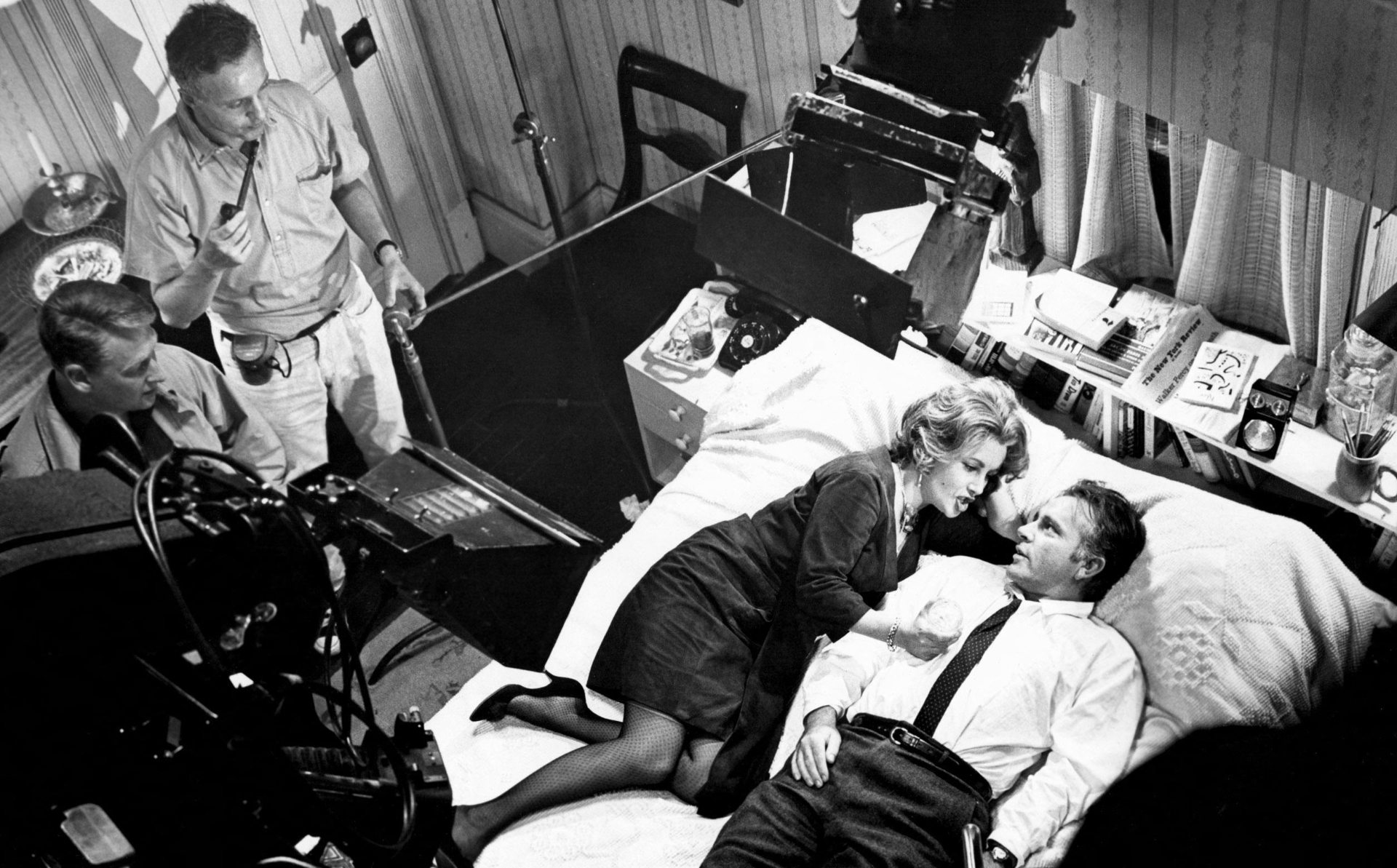
Nichols spoke about some of the differences he observed in Elizabeth and Richard’s approaches to their craft: “Elizabeth is very, very physical. What helps her is to know where she’ll be, what she’ll be wearing, and so forth—the business. . . . Richard is about the sound. He would say, ‘How should I say it? Say it for me.’ We found each other through rehearsals.”
Nichols rehearsed his actors as if they were preparing for a play, and he was impressed by Elizabeth's consummate skill as an actress. “[I]f I make suggestions, Elizabeth can keep in her mind fourteen dialogue changes, twelve floor marks, and ten pauses…”
“He is so inventive and has this peculiar, bizarre mind that sees only things that he can see,” Elizabeth said of Nichols. “He comes up with far-out ideas, some so minutely detailed that maybe the audience won’t even have time to catch them, but which mean so much to you as an actor.
“Like when I opened the icebox door in one scene. In front of me in that icebox I discovered a complete portrait of the total disorder of Martha’s mind and Martha’s life—and Mike had personally chosen and arranged everything. He had an ear of corn, all chewed and put away. There was a tangle of leftover spaghetti on a plate. A can of beans had been opened and left completely full, with the lid folded back. The icebox was packed with things like that. And in the scene I eat a leg of chicken and take the bone and stick it back in the icebox. Now the audience probably notices little of this, but it is all so important to stimulate the total of your performance.”
Elizabeth, then 33, gained 25 pounds, which was augmented by a salt-and-pepper wig and clever use of makeup, to play 45-year-old Martha. “In the wardrobe tests, assuming Martha, taking her on gradually, it was the walk that happened first,” she explained. “I can’t describe it. It’s a state of mind; it’s Martha’s walk. Then came the voice. It’s in a much lower key than my own, much more bawdy, much more raucous. I’ve done something with my accent, I don't know exactly what. The hardest thing was the laugh. Martha’s laugh is mostly vulgar. There are only one or two times that she laughs genuinely, from inside, and that’s quite a different one.”
Despite Edward Albee’s heavy dialogue and the film’s dramatic subject matter, the set of Who’s Afraid of Virginia Woolf? was a happy one and the atmosphere was often light and fun. In one moment of levity, Richard could be found trying on Elizabeth’s Martha wig for size.
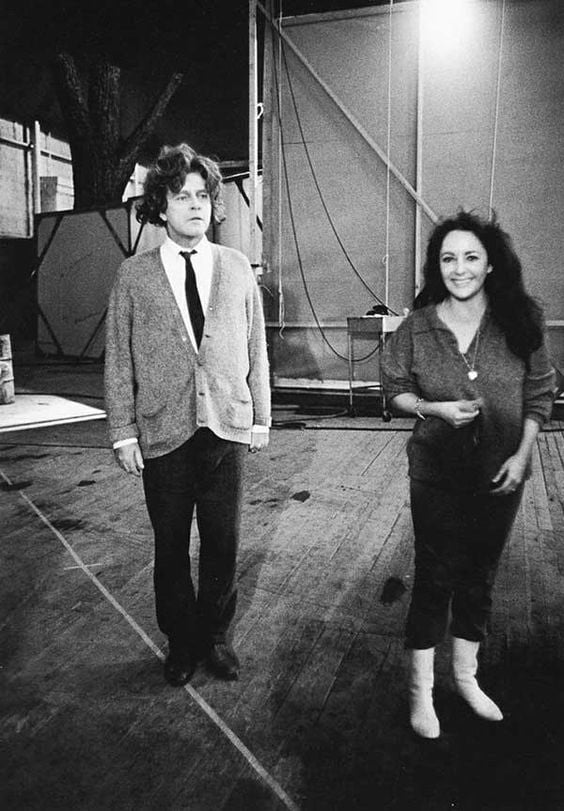
Coming in at $7.5 million, Who’s Afraid of Virginia Woolf? was the most expensive black and white film of its time. Its taboo subject matter and use of profanity broke new ground, ushering in a new era in filmmaking. It was nominated for 13 Oscars and won five, with Elizabeth’s name being called as the year’s Best Actress in what is arguably her finest performance. In winning her second Academy Award, she joined an elite group of four other actresses—Luise Rainer, Olivia de Havilland, Vivien Leigh, and Ingrid Bergman—who had achieved the same feat.
Elizabeth’s verdict on making the film? “I never had a better time in my life”.