Elizabeth Taylor’s Passion (1987)
While under contract to MGM, Elizabeth’s name and likeness were used to sell a range of products, from beauty items (Lux soap, Max Factor cosmetics, Luster-Creme shampoo, Woodbury Powder) and a line of hats to chocolate (Whitman’s Sampler) and ephemera (greeting cards, paper dolls, and painting and colouring books). In the decades that followed, Elizabeth was approached to endorse other products, but she was reluctant to take the plunge.
For Elizabeth, creating her own perfume was a natural. “I think [perfume] is more than just an accessory for a woman. It’s part of her aura. I wear it even when I’m alone.”
It was none other than Coco Chanel, the mastermind behind Chanel No. 5, who had once encouraged her to create her own fragrance. Now, she decided, the time was right. Elizabeth Taylor’s Passion was a joint venture between Elizabeth and Parfums International Ltd. She didn’t want to merely license her name; she wanted to be personally involved in every step of its year-and-a-half gestation.
That, of course, began with developing the perfect scent. “She would talk with a lot of knowledge and expertise and enthusiasm about frankincense and myrrh,” Tamara Steele, an Elizabeth Arden executive who would later collaborate with Elizabeth, told her authorized biographer, Kate Andersen Brower. “She knew a lot about ingredients, she knew what she liked. She felt that if people were buying her fragrance she wanted to be able to say it was something she wore herself and that she could be proud of.”
Prior to Passion, Elizabeth mixed three or four popular perfumes to create her own signature scent. With Passion, Elizabeth created her ideal perfume. “It’s a floral oriental, so it’s smoky floral, it’s not too sweet,” she said.
To Elizabeth, naming a fragrance “Passion” was a no-brainer; she couldn’t believe that another brand hadn’t beaten her to it. Passion, as she explained, was part of her makeup, part of her DNA. “Passion is the ingredient in me that has made me who I am,” she said. “It’s my passion for life . . . my passion for passion that has made me never give up.”
Selling Passion
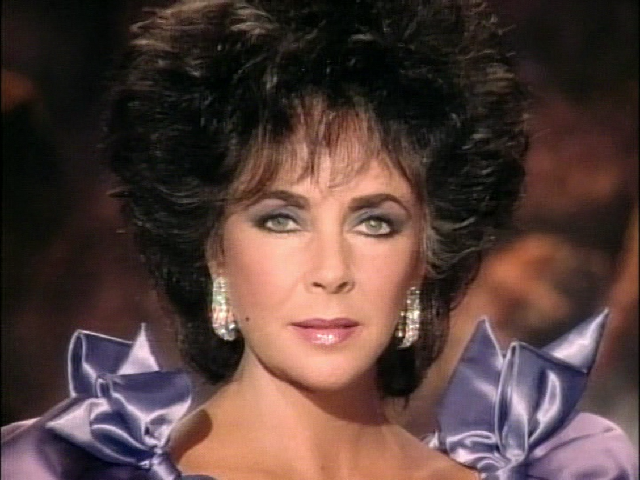
Elizabeth Taylor’s Passion was backed by a $10 million promotional campaign, which included print and TV advertisements and promotional photographs. The TV advertisement opens with Elizabeth, wearing a sumptuous Nolan Miller gown—a designer who was emblematic of the decadent 1980s, and one of personal favourites from that period—reciting a verse from American poet Helen Hunt Jackson’s Vanity of Vanities:
Bee to the blossom, moth to the flame;
Each to his passion; what’s in a name?
“Depends on the name,” she says. The camera then cuts to a well manicured hand lifting the stopper of Passion’s Art Deco-inspired purple bottle, before returning to Elizabeth, who quotes from Shakespeare’s Julius Caesar: “Passion, I see, is catching.” “I sure hope so,” she adds with a smile.
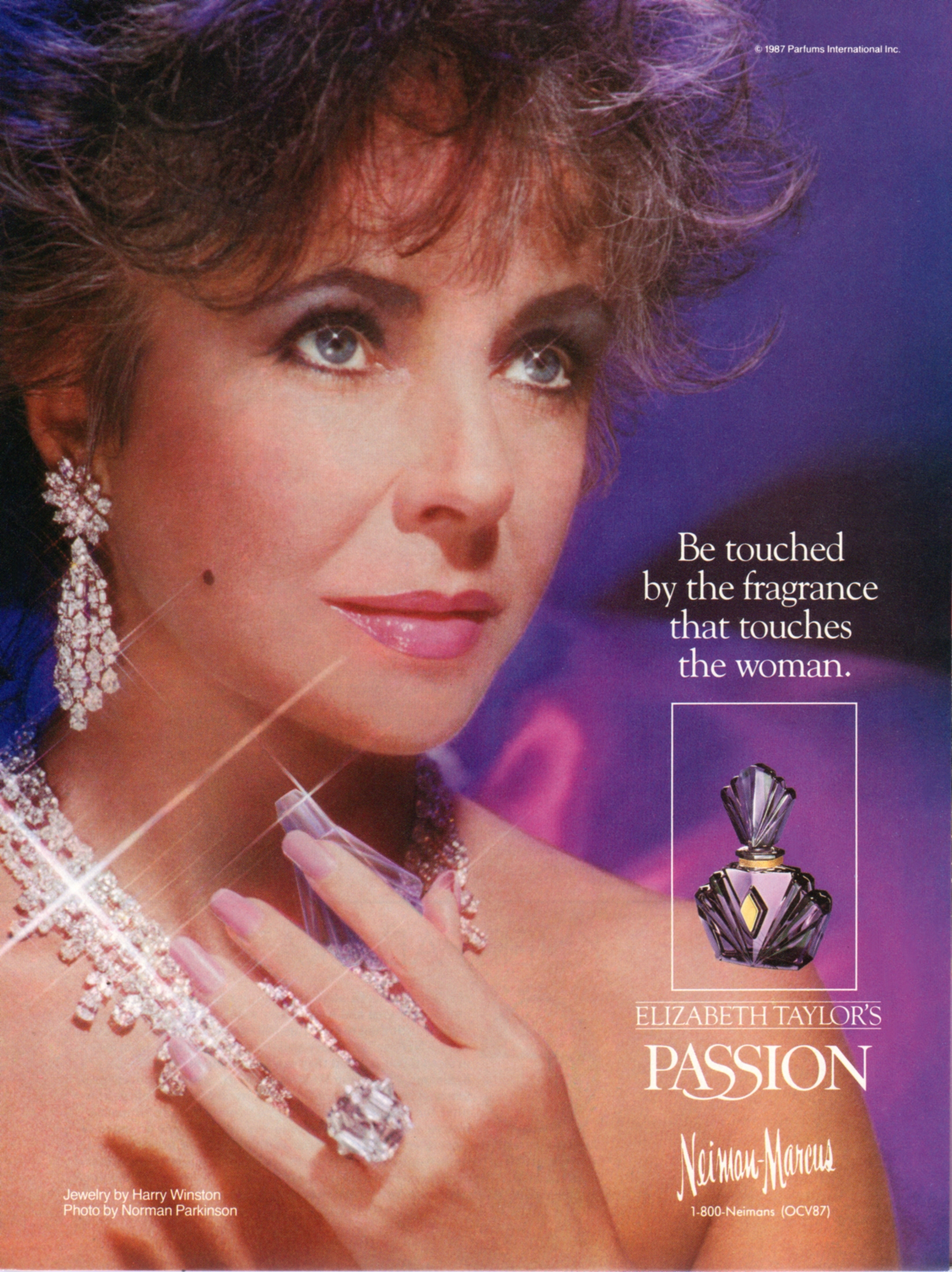
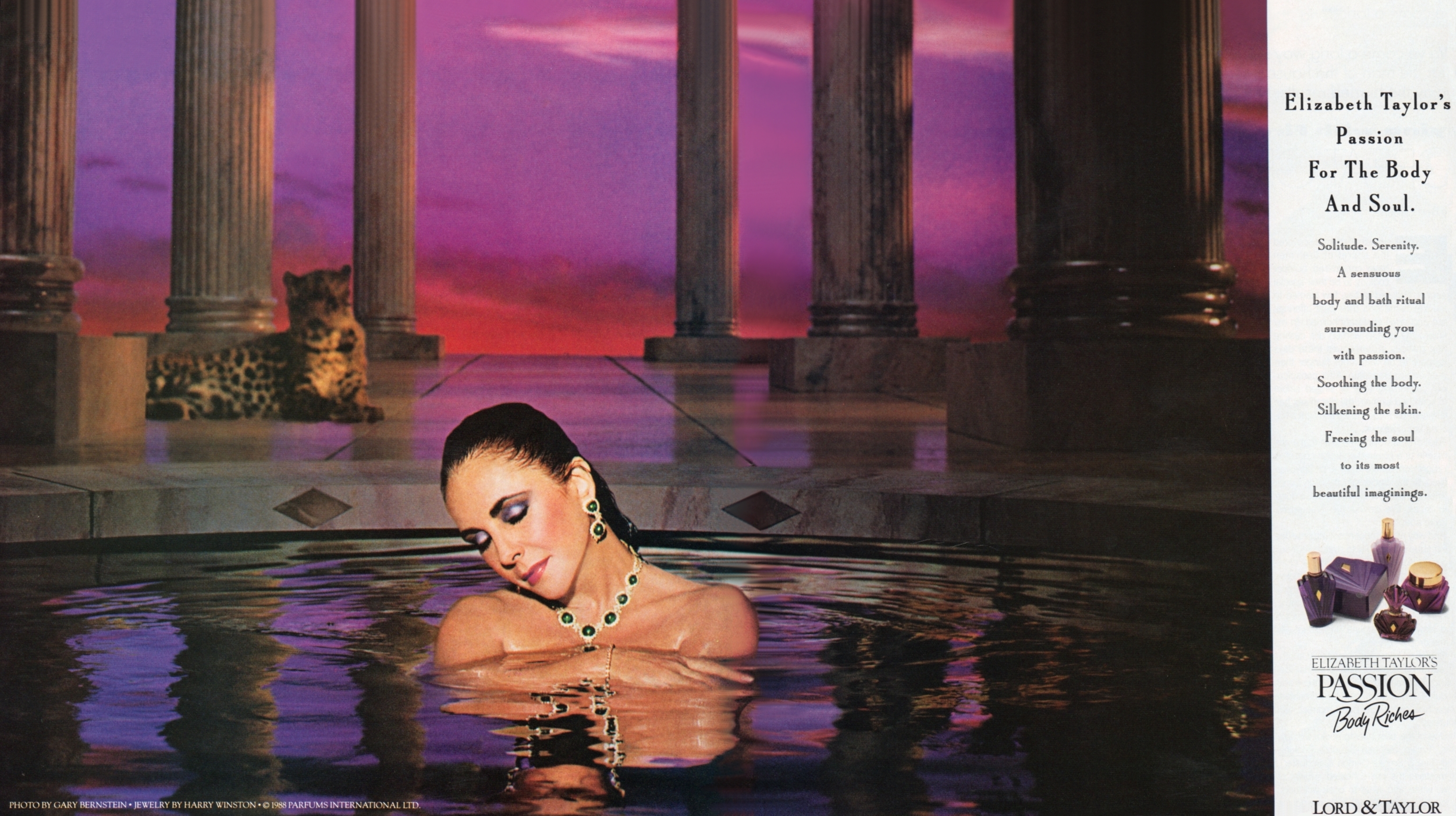
In Passion’s print advertisement, photographed by Norman Parkinson, Elizabeth drips in a Harry Winston necklace and earrings, one of the rare occasions when she wore “borrowed” jewelry. The Krupp diamond glitters prominently on a finger of the hand holding Passion’s stopper, poised to apply the fragrance. She also posed for a series of promotional photographs for Gary Bernstein’s camera wearing a succession of sumptuous Miller gowns.
Passion was an overnight success and is widely regarded as the first successful celebrity fragrance. It took home the FiFi Award—the fragrance industry’s equivalent to the Oscars—in the Fragrance of the Year – Women’s Prestige category in 1988. By 1991, sales had reached an estimated $100 million, earning it a coveted spot on the list of top ten selling fragrances of all time. But Elizabeth was just getting started.
The Art of the Perfume Tour
Starting with Elizabeth Taylor’s Passion, Elizabeth—and later, in the 1990s, with her partner in crime, her Maltese, Sugar, often in tow—would criss-cross the United States (with the odd stop in Canada, the UK, and France) to promote her latest fragrance. Typically between 4,000 and 10,000 fans would cram fine department stores, eager to catch a glimpse of Elizabeth. A lucky few even got to ask their idol a question during the Q&A portion! During these tours, Elizabeth would frequently make unpublicized visits with local AIDS patients.