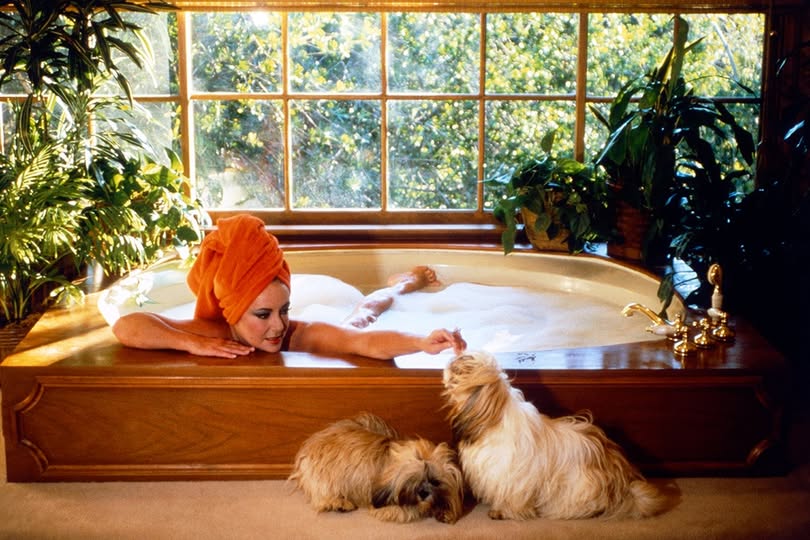
700 Nimes Road
Bel-Air, California
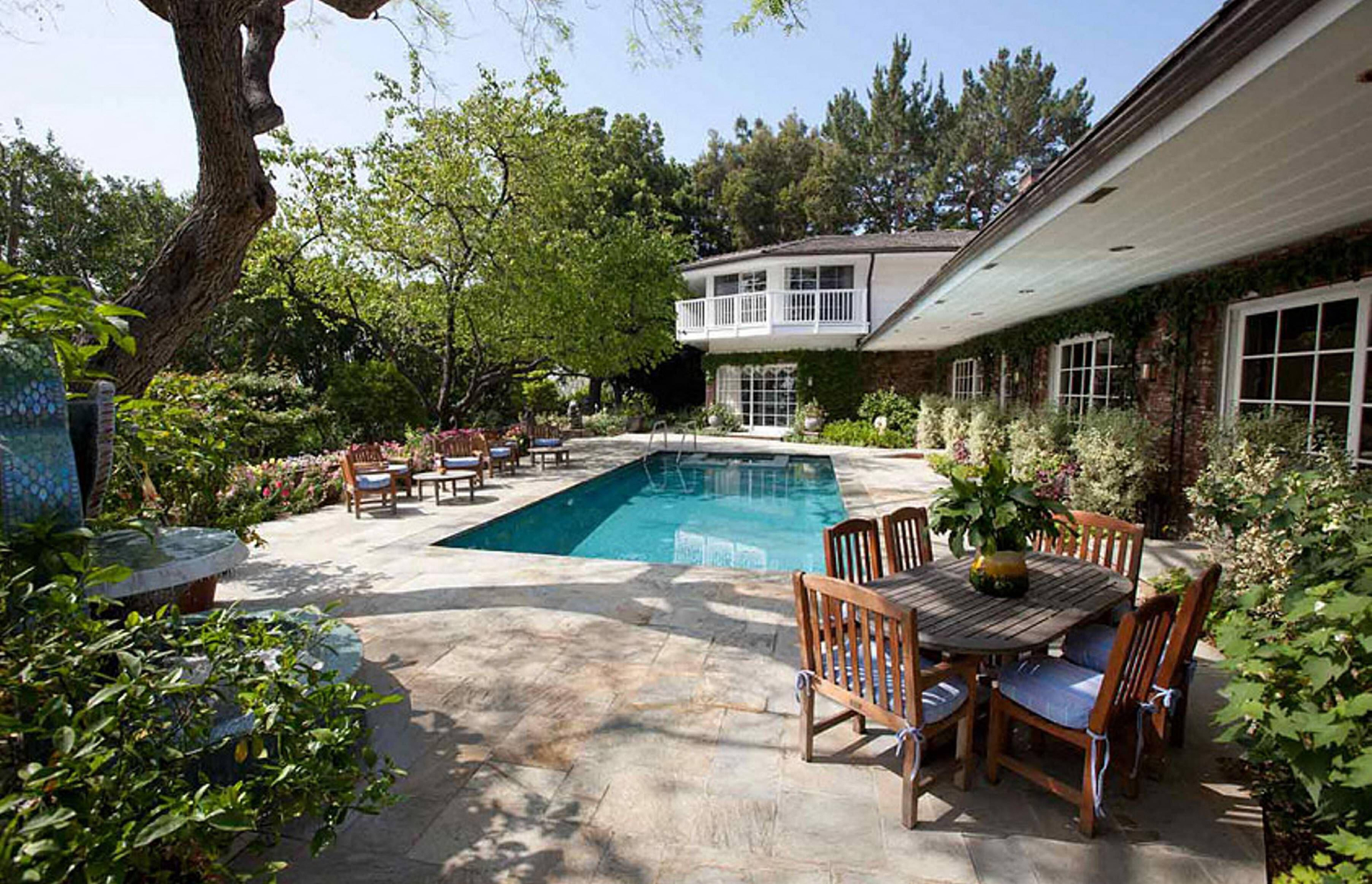
In 1981, Elizabeth was ready to move back to California and put down roots in the state she had called home from the age of seven, in 1939, until the early 1960s. Her realtor had lined up three properties to show her, but Elizabeth didn’t even see the other two. After viewing a 1960s ranch-style house on a 1.27 acre wooded lot in Bel-Air, her mind was made up. She decided to make an offer on the spot.
The home at 700 Nimes Road was formerly owned by Nancy Sinatra Sr. “When my mother and I lived [in the house] in the ‘60s, it was a contemporary bungalow, with a sort of Hawaiian-California feeling to it,” Nancy’s daughter, Tina, recalled. “My mother sold it to a developer, and he completely gutted the place and made it a two-story house. And then Elizabeth bought it from him.”
Inside, despite its 7,100 square feet, 700 Nimes Road retained a cozy feeling. White shag carpet ran throughout most of the main floor of the house, and many of the furnishings reflected Elizabeth’s fondness for Art Nouveau. Framed photos of loved ones covered walls and surfaces, and art adorned nearly every room, especially the living room, where her important collection of Impressionist art, including works by Pissarro and van Gogh, was arranged salon-style. Frans Hals’ Portrait of a Man hung above the fireplace, and the shelves flanking either side were brimming with equestrian figures by Elizabeth’s daughter, Liza Todd Tivey, an accomplished and highly-sought after sculptress, as well as an Estruscan amphorae, and other treasures. The living room’s vaulted ceilings were lined with warm wood, and beams ran the width of the room. French windows, which opened onto the garden, flooded it with natural light.


The living room gave onto the trophy room, where Elizabeth proudly displayed many of her awards and accolades, including her Oscars, as well as photos with Queen Elizabeth II and President Tito of Yugoslavia. The trophy room opened onto an intimate dining room (a table would be set up in the living room for larger gatherings). Completing the main floor was Elizabeth’s office/library and kitchen, where prospective chefs were put to the test by whipping up her favourite food, fried chicken.
The upstairs was given over to Elizabeth’s personal living quarters, and was home to her extensive collection of jewelry, clothes, shoes, handbags, and other accessories. In her dressing room, Irene Sharaff costume sketches for the Oxford stage version of Doctor Faustus, in which she co-starred alongside husband Richard Burton, adorned the walls. Her makeup was organized neatly on her dressing table, which was overflowing with more framed photographs.
“I can look out on the lovely garden, where one tree in particular inspires me if I am down. It has an exotic, magical quality, like the woods that come alive in The Wizard of Oz.”
But it was her bedroom that was truly Elizabeth’s personal sanctuary. A lamp in the Tiffany style, made by her son, Chris Wilding, sat atop a desk that was once her father’s. Hung above it was a painting by the Hungarian-born artist Marcel Vertès, commemorating the birth of her daughter with Mike Todd, Liza. Indeed, all of the art in Elizabeth’s bedroom was deeply personal. At one time, a Mary Casset painting of a mother and child—said to be Elizabeth’s favourite—hung above the bed. Paintings by her friend, legendary playwright Noël Coward, her mother, Sara, and even one of deer by a teenage Elizabeth herself, also adorned the walls. Her bedroom gave the feeling of being in a treehouse and, from its windows, Elizabeth said, “I can look out on the lovely garden, where one tree in particular inspires me if I am down. It has an exotic, magical quality, like the woods that come alive in The Wizard of Oz.”
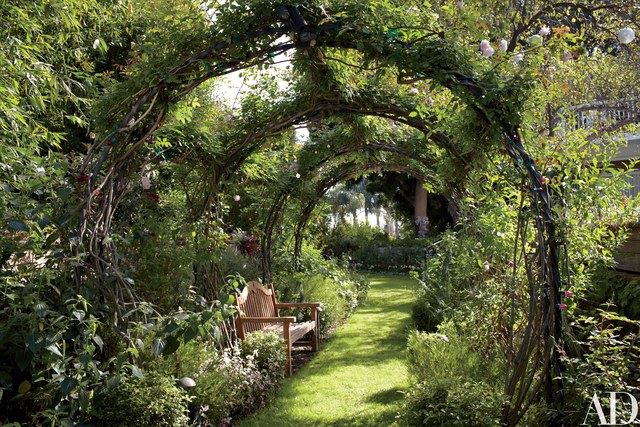
“My garden is my private world, filled with beauty and romance,” she once explained. “It’s a source of inspiration for many of my fragrances.” It would also play host to Sunday brunches and Easter celebrations. “It’s very festive, with lots of sunshine and balloons,” she said in 2004 of her Easter parties. Family and friends would gather in the garden and by her pool, where she would have a psychic, circus performers, and even a petting zoo for the younger revelers.
Elizabeth’s nephew, Christopher Taylor, painstakingly tiled the pool, and also designed its shell-shaped fountain. She could sit on a bench under an arbour of fragrant Cécile Brünner roses, and admire the pink cestrum and gold breath of heaven, as well as her namesake pink Elizabeth Taylor hybrid tea roses. She was also fond of the part of the garden she dubbed “the jungle”. With its palm fronds, birds-of-paradise, and bamboo, it was teeming with exotic birds and insects.
As her son, Chris, shared, “She never entertained the notion of moving.” Elizabeth would work with her friend, the interior designer Waldo Fernandez, to periodically refresh the interiors, most recently in 2010, the year before her death. “In recent years nearly every room was awash in blues and lavenders, shades echoing Taylor’s famed violet eyes,” wrote Mitchell Owens in Architectural Digest. She had given permission for her dear friend, Firooz Zahedi, to photograph her beloved home and gardens for the magazine shortly before her death. (Around the same time, photographer Catherine Opie also captured Elizabeth’s rooms and collections for posterity, which she published in a 2015 coffee table book titled 700 Nimes Road.)
After a lifetime spent in the glare of the public eye, Elizabeth’s home and gardens at 700 Nimes Road were totally relaxed and unpretentious. They were designed for family, pets, and, in a lifetime that was filled with so many of them, creating more memories with the people she loved most.